


Learning to Become Citizens: An Empowering Outcome of TASS
The Telangana Aadapillala Samanatva Samakhya ( TASS – Telangana Adolescent Girls Federation for Gender Equality) is an initiative of the members of the Kishore Balika Sanghams (KBS) or Adolescent Girls’ Committees set up by the Ika Chaalu project. It was established on 24 April 2024 at the express wishes of the girls in the project who wanted to start a state-wide movement to share their learnings on gender and education rights. To date several activities have been conducted under the aegis of this federation. The following is an account of the outcomes of the activities undertaken by TASS till date.
“When children become agents of change, change happens.”
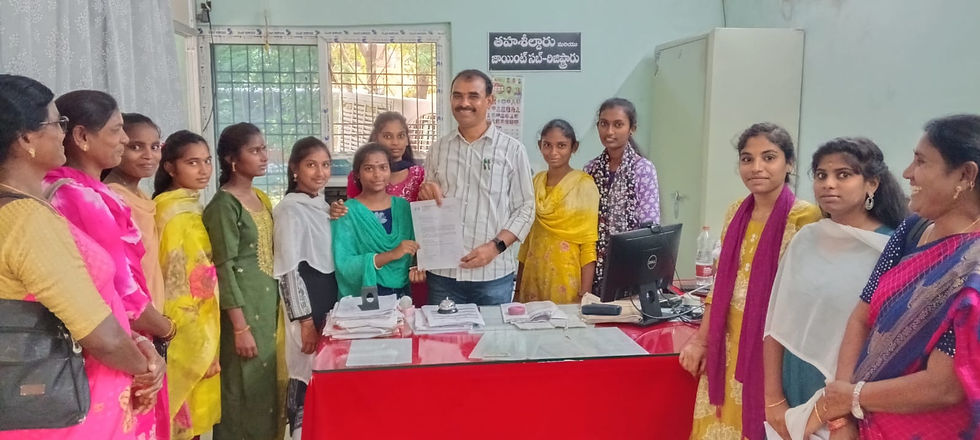
Across villages and mandals, girls who are members of KBS and TASS are increasingly entering public spaces, raising questions, making demands and approaching institutions. Many of these girls are only twelve to fifteen years old.
They are petitioning the Sarpanch, approaching the Depot Manager for more buses, meeting the District Collector, speaking to teachers and police officials, intervening in child marriages and demanding that government programmes respond to their concerns. They are questioning gender discrimination and asking why elected women representatives are replaced by their husbands in Gram Panchayat (elected local government) meetings. They are demanding that boys and girls participate together in public life. They are learning to speak about their rights, and fight for them.
In short, the girls are becoming young citizens who can identify problems, locate responsibility, approach institutions and demand a response. This transformation, dramatic though it is, has not been smooth.
Making the Right to Education a Reality
The struggle for buses is one of the clearest examples of this. Girls travelling long distances to school and college found that unreliable transport was an obstacle to continuing their education. They petitioned the Sarpanch (head of elected local government) and the bus Depot Manager, resulting in buses reaching six villages during school and college timings. In other villages, Gram Panchayats negotiated with auto rickshaw drivers to provide free rides. Similarly, their demand for a room of their own succeeded in six colleges. This request emerged from real life circumstances where they have to undertake long journeys, work before and after college, sometimes go hungry, and the need for a place to rest during menstruation.
The girls have also demanded repairs of roads, better playgrounds, more classrooms and teachers, libraries, books and newspapers. They have petitioned for scholarships to be released on time and for good-quality uniforms and textbooks. What may seem like a list of infrastructure demands is actually a claim to the conditions that make their participation in education possible. It is a part of the infrastructure of dignity and retention. What was once considered an individual difficulty has now become a public question.

Transformation From the Family to the Gram Panchayat
Parents who initially resisted their daughters' participation in public activities have gradually begun to recognise the value of their participation. One grandmother, moved by her granddaughter's achievement, mortgaged the silver anklet she had worn for years to fund her admission to a Multi-Purpose Health Workers course — a connection to a future she had never imagined. For the entire family, higher education for the girl has become a matter of pride and for the first time, a real possibility.
Girls have also begun interacting with the Gram Panchayat. In Vikarabad, Panchayats have started inviting two KBS representatives to their meetings; the girls immediately asked that two boys be included too, and that they be given advance notice so they could arrange their school commitments. The girls are active participants in these meetings, they raise issues pertaining to their education and are beginning to negotiate the terms on which they participate as citizens. Madanapally panchayat of Vikarabad mandal got an award for conducting a Bal Panchayat (children’s panchayat) in which the KBS girls were actively involved.
The girls are also vocal on the issue of gender equality and women’s political rights and they have found the courage to challenge existing practices that violate these rights. For example, in one Gram Panchayat, the husband of an elected woman member had been attending meetings as her proxy — a practice that has been normalised. The girls asked why he was attending and not her, thus challenging an entrenched practice in which informal male authority had displaced the formal democratic authority of an elected woman. The Sarpanch was compelled to call the woman and ask her to attend herself.[Lv1] The girls are active participants in the gram panchayats and are beginning to negotiate the terms on which they participate as citizens, thus becoming part of the democratic space.
When Children Become Political Actors
The transformation in the girls can be seen particularly clearly during the Gram Panchayat elections. Initially, the candidates did not take their demands seriously. Not disheartened, the girls brought boys along and presented a collective children's agenda covering schools, infrastructure and teachers' attitudes. After the elections, the same representatives began listening to them with respect.
The girls' demands also show that their understanding of politics is extending beyond conventional “children's issues” or “girls' issues” to timely and increased scholarships, degree colleges in every mandal, greater public investment in education, a Minister exclusively responsible for education, full-day colleges, continuation of polytechnic education and opportunities for lateral entry. They are questioning the ‘The Young India Skills University, Telangana (Public-Private Partnership) Act, 2024”, which would merge all existing public polytechnic institutions with the new University. The girls feared this would lead to the privatisation of polytechnic education, and make it unaffordable and inaccessible. A particularly striking demand is that all government ministries must talk to each other and identify their responsibility towards children and that every department must specify its contribution to the education of children. The girls are beginning to see that children's lives do not fit neatly into departmental boundaries. Education is connected to transport, social welfare, health, safety, nutrition and economic support. The responsibility for children must, therefore, belong to each and every department.
What is a Gender Issue?
When girls petitioned the District Collector about transport, they were told transport was not a gender issue. They disagreed: a missing bus restricts their mobility; a missing scholarship can push a girl towards marriage; the absence of toilets or restrooms affects schoolgirls differently, an unsafe road or inaccessible transport can end a girl's education. They were defining gender equality through the conditions of everyday life — the ability to travel, study, remain in education, participate in public life and access resources. They were expanding the meaning of gender equality beyond the familiar language of violence, marriage and discrimination. In a government meeting, a KBS member asked whether education could really be called free when girls had to pay for transport, when government schools were inadequate and private education was unaffordable. She questioned why the government needed the Kalyana Lakshmi Scheme[1] when it could instead encourage girls to continue studying and provide scholarships.
This tension surfaced sharply around the government's SNEHA programme – an initiative of the Telangana government that focuses on adolescent girls in the 15-18 age group. So far, about 6000 ‘Sneha Sanghas’ or groups of adolescent girls have been formed in villages across Telangana to orient them on health awareness, menstrual hygiene, digital literacy , skill training and leadership, along with preventing child marriages, violence and exploitation. They function on the women’s Self Help Group model. Local officials initially preferred to keep the already-organised KBS girls out of their meetings. Their eventual inclusion in a district SNEHA committee is therefore significant. It marks the entry of an independent, questioning group of young citizens onto a state platform.

Girls and Boys: Solidarity
The changing relationship between girls and boys is another important development. Girls have experienced stalking, rude behaviour and sexual harassment from boys while travelling to school, and have not hesitated to complain to the police. Police counselling and patrolling have followed in some places, making the girls feel safer. At the same time, they've chosen not to treat boys purely as adversaries and decided to reach out to them. They can see that some boys are neglecting their studies, dropping out and going to work, joining street-corner groups and using drugs, with consequences for themselves and their families. They feel that boys need education, support and opportunities. In one village, girls arranged mathematics tuition for the boys through the Gram Panchayat after boys said they were failing because they couldn’t stay focused. At the same time, the girls are clear that harmful behaviour towards them is unacceptable.
There is a remarkable maturity in this combination of solidarity and accountability — talking to boys while holding them responsible for their behaviour. The girls are learning that gender equality requires boys and questions of masculinity to be part of the conversation. The change in the boys and their conversations with girls is visible in everyday relationships in some villages. Girls and boys increasingly describe themselves as friends. They study and play together. Girls participate in volleyball and other sports traditionally restricted to boys, including in district and state competitions. Boys who have participated in gender committees from an early age are more conscious of gender discrimination and some even call themselves feminists with pride.
There is still much to be done. Boys are not easily available for meetings. They have short attention spans and can be easily distracted by peer groups that expect them to do what is seen as “male”.
Change in Schools
Perhaps the most revealing evidence of change is what the girls are no longer willing to tolerate in schools. In one school, a teacher insulted girls for poor performance, telling them that if they did not improve they should get married or commit suicide. As they put it: “Earlier girls would accept such insults. No more now!” This time they complained to the Sarpanch. The teacher received a stern warning and corrected his behaviour. The important change is that the girls' threshold of what they will tolerate has changed. Humiliation by an authority figure is now recognised as unacceptable behaviour; the girls know whom to approach to complain and they expect the institution to respond. This is a training in citizenship.
Protecting One Another
The girls' growing agency is especially visible in their interventions around child marriage. Ten years ago child marriages were conducted openly. Fear of the law and of KBS activism gradually pushed them underground, and in recent years they are reported to have become rare in many places, especially in the Ika Chaalu project area. Girls have themselves become part of the protective system , campaigning in villages, contacting Childline and the Child Welfare Committee, and intervening directly to stop marriages. This, combined with social mobilisation, public awareness and sensitisation on gender equality has made the change possible. The girls are learning how to seek protection and, increasingly, how to protect one another.
What Constitutes Success?
When the girls share their experiences it becomes clear that what constitutes success is the capacity to recognise injustice, build solidarity, navigate multiple layers of power, engage with official and non-official actors, persist through resistance and return to the struggle when the first attempt does not succeed. Success and achievement go beyond the number of petitions made, meetings held or children who participated in an action. Often there is no positive response from the authorities for a petition made. For example, a bus to the village may not be sanctioned immediately, or a demand for scholarships receives no response and school infrastructure remains the same in spite of repeated requests. Success is more than a tangible result or a quantifiable number as the more profound outcome is that the girls are learning to navigate a whole social and institutional ecology and different layers of power in the family, peers, boys, community, Panchayat, schools, police, welfare structures, mandal and district officials, and the state. Success is what they become capable of doing.
Each time the girls act collectively, negotiate, persist or return when there is no response they acquire something that cannot be measured by whether a particular demand was accepted. They learn whom to approach, how to speak, how to persuade, when to negotiate, when to insist, how to build alliances and how to move between different layers of power. The processes through which the girls learn to act is therefore as important as the results they obtain. An unsuccessful action can still enlarge a girl’s political repertoire. The outcomes matter, but so does the capacity to continue acting when outcomes do not come easily.
Success Creates New Contests
The story does not end with success. It changes the terrain on which the next struggle takes place. It creates new aspirations, demands and contests that open the next phase of change. Once girls get the bus, the question becomes whether it is timely, safe and adequate. Once they enter the Panchayat, the question becomes what they can influence there. Once they challenge harassment, questions of boys’ behaviour, relationships and gender norms emerge. Once girls remain in education, the question becomes what higher education is available and affordable. Once they acquire confidence, they begin questioning government policy itself. The work of mobilisation is thus unending as every achievement is both an end and a beginning. It makes a previously unimaginable possibility ordinary, even as it generates new possibilities, new expectations and new questions and it strengthens the movement.
[1] The Kalyana Lakshmi Pathakam is a welfare initiative by the Government of Telangana that provides one-time financial assistance of ₹1,00,116 to support the marriage expenses of resident brides from economically distressed families.


Comments